
From tech hype to tech reality: Lessons learnt
Our Director Andrew Wielandt knows firsthand that upgrading a financial advice tech stack is rarely as straightforward as it looks. We break down what the journey taught our team.
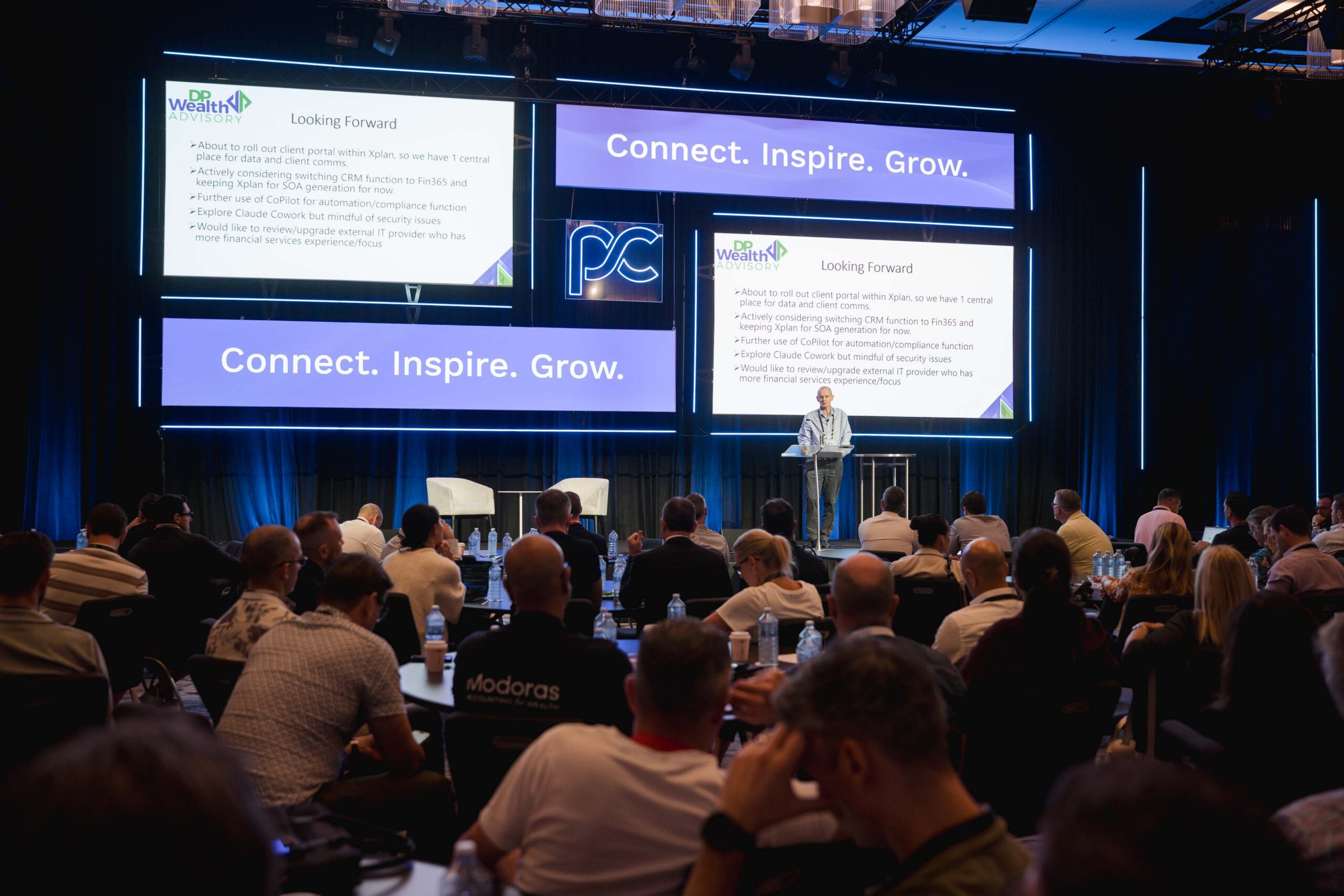
Our director, Andrew Wielandt, recently attended the 2026 Principals’ Forum and presented a session titled “Tech Hype to Tech Reality.” Drawing on our company’s experience modernising technology, Andrew shared an honest account of the journey, what worked, what didn’t, and what the practice would do differently.
In this piece, we cover Andrew’s key takeaways from the session.
Where it all started
DP Wealth Advisory’s technology history dates back to the late 1990s, beginning with Macquarie’s infrastructure before moving to an independent AFSL, with on-premises hardware, MS Office, and ACT as the core tools. Over time, the practice moved to Xplan, the dominant market leader in financial advice software, and built out a broader technology ecosystem around it.
The turning point came when the team recognised they weren’t getting as much from their technology as they should. Their IT consultant was skilled at solving problems as they arose, but wasn’t positioned to anticipate what the practice actually needed to grow. Bringing in a practice management consultant gave them the outside perspective to figure out where to go next.
What the current setup looks like
The key focus with Xplan was on workflows.
The team needed support to manage the change while balancing the pull of everyday client demands, and it took multiple rounds of training and in-office mentoring for the new ways of working to take hold.
The current tech environment also includes:
- Calendly for booking client appointments
- Built by Simply Advice Websites, our new website goes beyond improving brand and authority, intelligently connecting new enquiries with the adviser best suited to each individual’s needs and availability. It represents a genuine win for clients and our practice.
- Claras, a pioneer in AI-assisted file note-taking, is used for file note preparation and SOA documentation
- CoPilot is used by management to analyse data, particularly within Excel
What’s on the horizon
The practice is currently rolling out Xplan’s client portal to centralise data and client communications in one place. Also on the table is a potential move to Fin365, an emerging leader in CRM built on Microsoft infrastructure, while retaining Xplan for SOA generation in the meantime. Further use of CoPilot for automation and compliance is on the agenda, along with a review of their external IT provider.
The value of bringing in outside expertise
An external consultant brings the kind of objectivity that’s hard to maintain from inside a busy practice. They can see the gaps, prioritise what actually needs addressing, and keep the project moving when day-to-day pressures get in the way.
For many small and growing businesses, the pattern of relying solely on a provider skilled at fixing problems but not at anticipating them is common and costly. Having someone who can take a strategic view, not just a technical one, makes a real difference.
Planning for disruption before it happens
Changing technology is genuinely disruptive, and Andrew was direct about the fact that the transition took longer and was harder than anticipated. The lesson isn’t to avoid change, but to plan for it. That means setting aside enough time and resourcing, building in proper training, and defining clear measures of success before the project begins rather than trying to assess it mid-stream.
It also means being honest about what “done” looks like. Technology in a financial advice practice is never truly finished. Continuous improvement is best approached as an ongoing conversation rather than a one-off project, with the earlier reference point being something to build on, not replace entirely.
Getting your team across the line
Technology change works best when the whole team is part of the journey. Communicating the why, investing in proper training, and holding everyone to account through the transition are what turn a good platform into a genuinely effective one. The practices that see the strongest results are those that treat implementation as a people project just as much as a technology one.
Having a strategy, not just a tool list
Without a defined plan, it’s easy to be pulled toward whatever looks promising at the time, adding tools that don’t integrate well or solving problems that aren’t the real constraint. A clear strategy gives a practice something to evaluate new options against, and makes it easier to stay focused when the market is full of noise about the next thing.

What this means for your financial advice
For clients, the technology a practice runs on is rarely top of mind. But it shapes everything from how smoothly appointments are booked, to how accurately records are kept, to how well an adviser can stay across your situation over time. Andrew’s participation at events like the Principals’ Forum is part of how DP Wealth Advisory stays current, not just with investment thinking, but with the operational standards that make good advice possible.
If you have questions about how DP Wealth Advisory works, or want to understand the advice process, we’d love to have that conversation with you and invite you to get in touch.
This website is produced as an information service only without assuming responsibility. It contains general information only and should not be relied on as a substitute for financial or other professional advice. For further information please read our important information.





Get DP Wealth Advisory insights in your inbox

"*" indicates required fields